The Thread That Holds
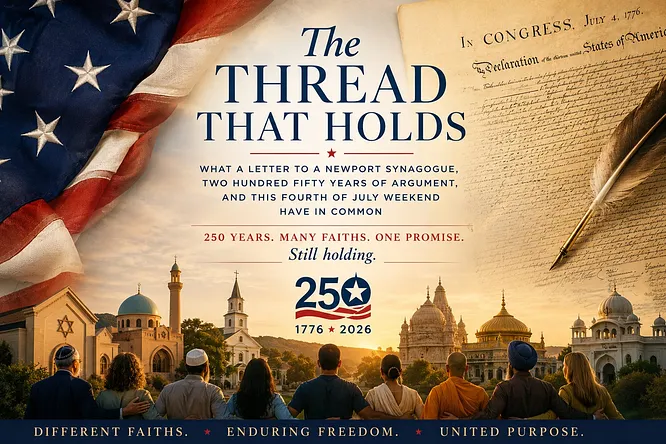
What a letter to a Newport synagogue, two hundred fifty years of argument, and this Fourth of July weekend have in common
This weekend, the country turns 250. There will be flags on porches and traffic on the interstate and somebody’s uncle burning the burgers, and if you turn on the news in between, you’ll hear, correctly, that we’re divided, that we don’t trust each other, that we can’t agree on much of anything. All of that is true. It’s just never been the whole story.
The whole story starts earlier than most people think. In August of 1790, not even a year into his presidency, George Washington wrote a letter to a synagogue. The Hebrew Congregation of Newport, Rhode Island, had written to welcome him to their city, and what he wrote back has outlasted nearly everything else from that visit: that the government of the United States “gives to bigotry no sanction, to persecution no assistance,” and asks of its citizens only that they be good ones. That sentence was written to a small Jewish community in a country that was, at the time, overwhelmingly Protestant. It didn’t have to be written. It was a bet that this country would not be built on whose God you pray to, but on whether you were a good citizen. And it would hold that bet even for the people who looked and prayed and sounded nothing like the majority.
We’ve been cashing that bet, testing it, and occasionally defaulting on it, for 250 years. But it was never kept safe by a document; documents don’t hold anything, people do. Every time this country has been dragged, kicking and arguing, back toward the promise it made itself, it’s been people of faith doing the dragging: Quakers, Catholics, Jews and Muslims and Sikhs and Hindus, Jains, Buddhists and atheists, each standing up in turn and saying, you said this applied to everyone, so make it apply to us too. That’s the thread. It runs through 250 years of American argument without ever breaking, because somebody has always been there to pick it back up.

Which is the whole point: faith leaders were never asking for a seat at the table. They built the table. They’ve held this country up from the beginning, called to uphold the principles enshrined in the Constitution not once, not in 1776 alone, but today and every day between, guardians and protectors of the democracy itself, not from the outside cheering it on, but from the inside, holding it to its own word.
And that’s why the diversity of faith in this country isn’t the thing threatening to tear it apart. It’s the single greatest source of strength we have. Anyone can build a nation of one faith and ask it to be tolerant; that’s not a hard bet to make. This country made the hard one:
that a synagogue in Newport, a mosque in Dearborn, and a Baptist church in rural Georgia, a Hindu temple in Fremont, would all be equally, unambiguously American. Two hundred fifty years later, against every reasonable expectation, that bet is still standing; not because we stopped disagreeing, but because we never stopped showing up for each other anyway.

Which means it doesn’t matter if your family has been here since before the Revolution or got here last year. It doesn’t matter if you’re a first-generation American starting your career or a ninth-generation descendant of the people who founded this thing. The thread was never about who got here first. It was about whether we’d hold each other’s freedom as seriously as we hold our own; not a nostalgic idea, but a live one, waiting to see if this generation picks it up the way every one before it did.
So don’t spend this weekend polishing the country’s history until it shines. Spend it doing what faith leaders have done since before Washington picked up that pen: telling the truth about where the promise is being kept, and where it isn’t, and getting back to the work of keeping it. That’s not cynicism. That’s the most hopeful thing a person can do, because it’s the only thing that has ever actually worked.Two hundred fifty years in, the thread is still here. A little frayed. Still holding. And it’s going to take every tradition we’ve got to hand it off in one piece to whoever comes next.
Happy 250th. Let’s go make it worth another 250.